
Bitumen is one of the most widely used petroleum-based materials in infrastructure, road construction, waterproofing, and industrial applications. Its durability, water resistance, adhesive properties, and ability to perform under different temperatures make it an important commodity in international trade.
For buyers, contractors, distributors, and industrial companies, understanding what bitumen is, what it is used for, and how different bitumen grades compare is essential when selecting the right product for a project.
What Is Bitumen?
Bitumen is a viscous, black or dark-colored petroleum-based material produced primarily through the refining of crude oil. It is highly resistant to water and has strong adhesive and binding properties, which makes it particularly suitable for construction and infrastructure applications.
Bitumen is commonly associated with asphalt, but the two terms are not exactly interchangeable. Bitumen is the binding component, while asphalt is generally a mixture containing bitumen, aggregates, and other materials.
The physical properties of bitumen can vary depending on its grade, production process, crude oil source, and intended application. This is why selecting the appropriate bitumen grade is important for achieving the required performance.

What Is Bitumen Used For?
The largest application of bitumen is road construction and maintenance. It acts as a binder that holds aggregates together and provides flexibility, durability, and resistance to water.
However, bitumen has many other applications.
1. Road Construction
Bitumen is widely used in asphalt mixtures for roads, highways, airport runways, bridges, and parking areas. Its binding properties help create a durable surface capable of handling traffic and environmental conditions.
2. Waterproofing
Bitumen is also used extensively in waterproofing applications. Bitumen-based membranes and coatings can protect roofs, foundations, underground structures, tunnels, and other construction elements from water penetration.
3. Roofing
Modified bitumen products are commonly used in roofing systems because of their water resistance and durability. They can provide an effective protective layer for commercial and residential buildings.
4. Industrial Applications
Bitumen can also be used in pipe coating, corrosion protection, insulation, sealants, and various industrial products where water resistance and adhesion are important.

Understanding Bitumen Grades
Bitumen is available in different grades, and each grade has specific physical characteristics that make it suitable for different applications.
One of the most common systems used to classify paving bitumen is penetration grade. In this system, the grade indicates the penetration range of the material under standardized testing conditions.
Common grades include:
- Bitumen 40/50
- Bitumen 60/70
- Bitumen 80/100
- Bitumen 85/100
- Bitumen 160/220
The numbers refer to the penetration range measured in 0.1 millimeters (dmm) under a standardized test, generally at 25°C.
In simple terms, a higher penetration number generally indicates a softer bitumen, while a lower penetration number indicates a harder bitumen.
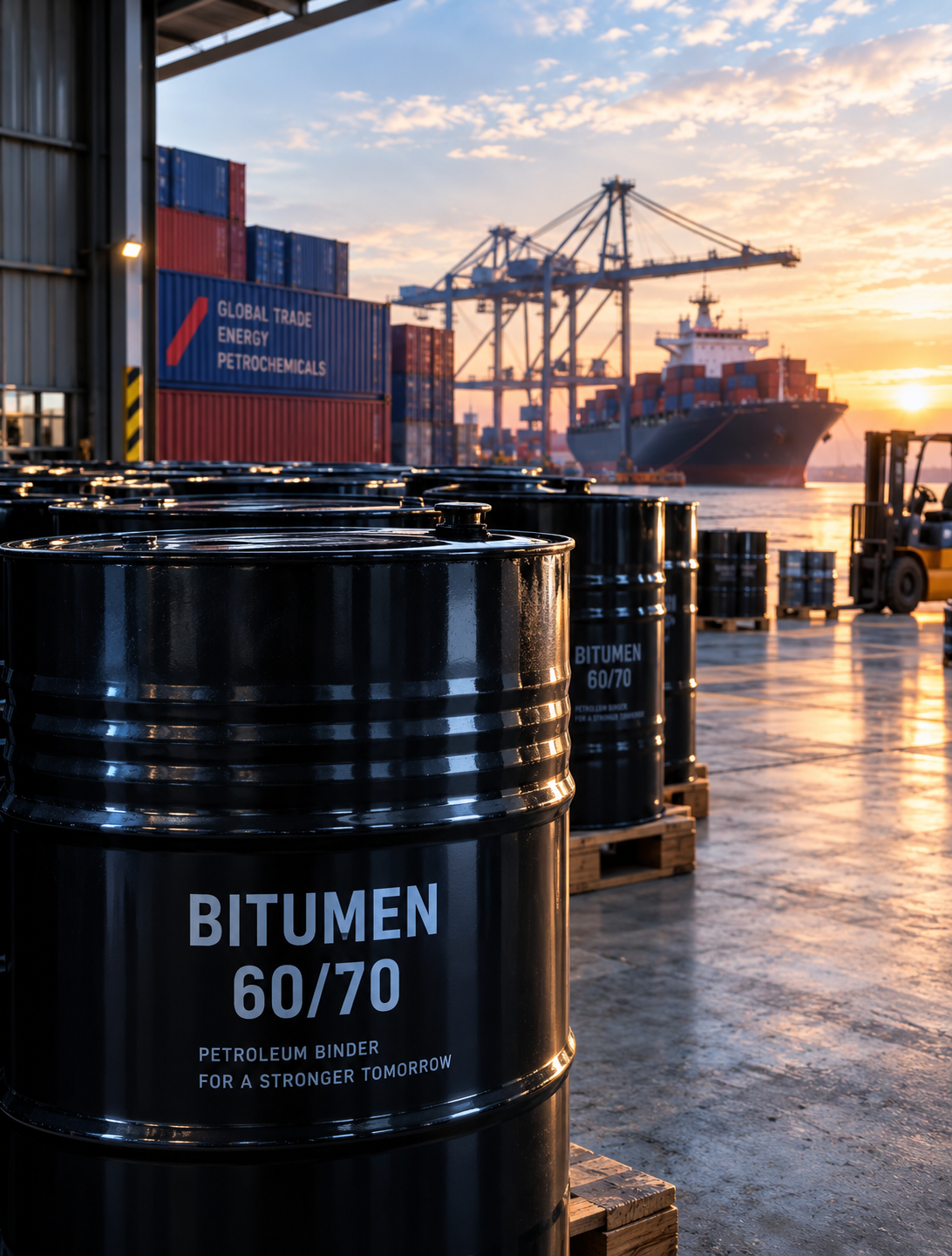
Bitumen 60/70
Bitumen 60/70 is one of the most widely traded paving grades. It provides a balance between hardness, flexibility, and temperature performance, making it suitable for many road construction and asphalt applications.
It is commonly used in road paving, asphalt mixtures, highway construction, and maintenance projects.
For international buyers, Bitumen 60/70 is often selected when a versatile paving-grade bitumen is required.
Bitumen 85/100
Bitumen 85/100 is softer than Bitumen 60/70 because it has a higher penetration range.
It can be suitable for applications where greater flexibility is required, particularly in environments or pavement conditions where a softer binder may provide advantages.
The appropriate grade should always be selected based on project specifications, climate, pavement design, and applicable standards.
Bitumen 160/220
Bitumen 160/220 is a significantly softer penetration-grade bitumen. Its higher penetration range makes it suitable for applications where a softer and more flexible binder is required.
As with other grades, the correct application depends on project requirements, local climate, technical specifications, and the standards required by the buyer or end user.
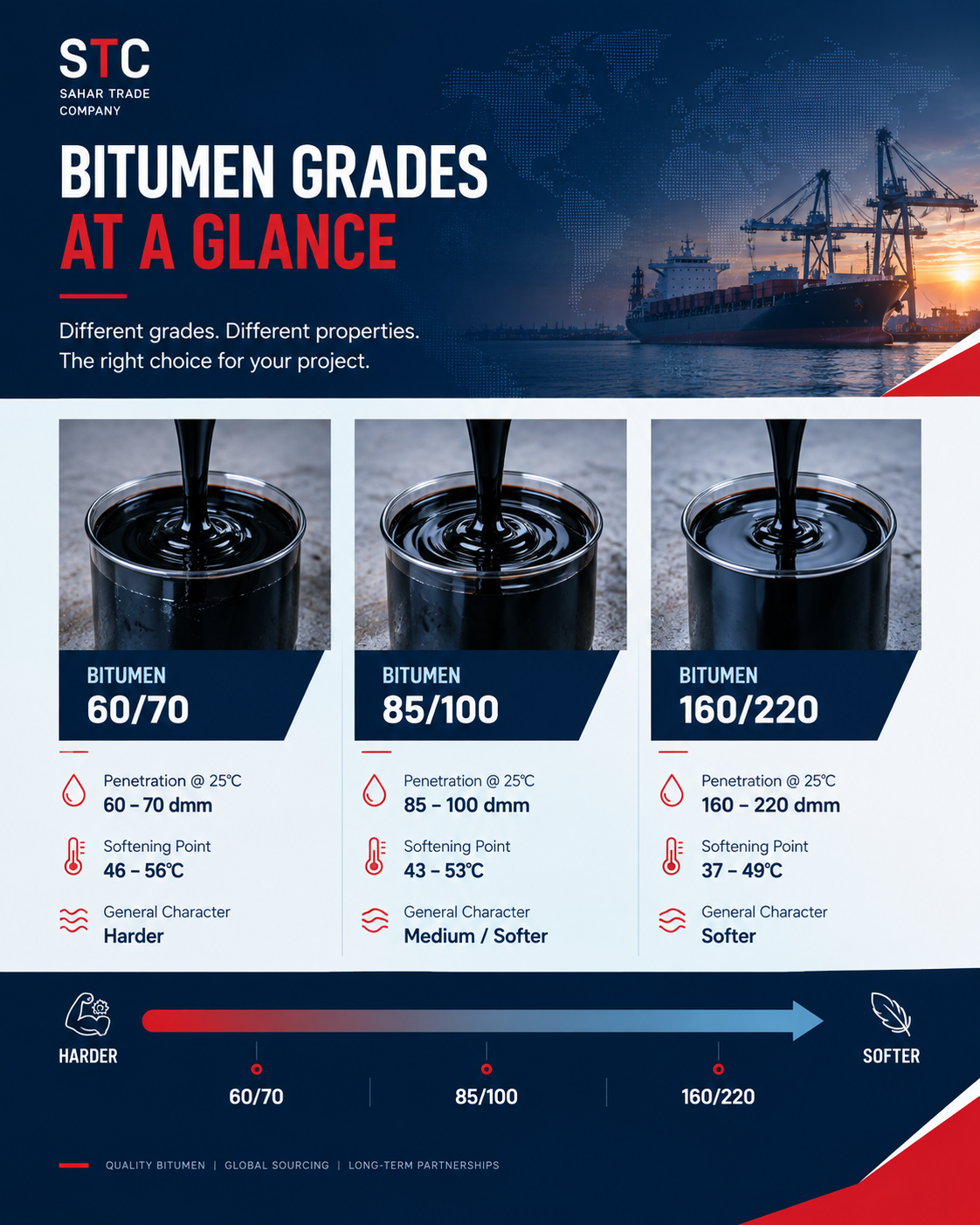
Bitumen 60/70 vs. 85/100 vs. 160/220
The main difference between these grades is their penetration range and resulting physical characteristics.
| Specification | 60/70 | 85/100 | 160/220 |
|---|---|---|---|
| Penetration @ 25°C | 60–70 dmm | 85–100 dmm | 160–220 dmm |
| Softening Point | 46–56°C | 45–52°C | 35–43°C |
| Ductility @ 25°C | ≥100 cm | ≥100 cm | ≥100 cm |
| Specific Gravity @ 25°C | 1.01–1.06 | 1.01–1.05 | 1.01–1.06 |
| Flash Point | ≥232°C | ≥232°C | ≥250°C |
| Solubility | ≥99% | ≥99.5% | ≥99.5% |
| Loss on Heating | ≤0.5% | ≤0.5% | ≤0.2% |
A lower penetration grade is generally harder, while a higher penetration grade is generally softer.
However, penetration alone should not be the only factor considered when selecting a product.
How to Choose the Right Bitumen Grade
Choosing the right bitumen grade depends on several factors.
1. Climate and Temperature
Temperature is one of the most important considerations. The performance requirements of bitumen can differ significantly between hot and cold climates.
2. Project Type
Road construction, airport pavements, waterproofing, roofing, and industrial applications may require different bitumen characteristics.
3. Technical Specifications
Buyers should always compare the required specifications with the supplier’s product analysis. Important parameters can include penetration, softening point, ductility, flash point, solubility, and loss on heating.
4. Origin and Supply Requirements
For international procurement, buyers may also need to consider the country of origin, available quantity, packaging, loading port, shipping requirements, and applicable trade terms.
At Sahar Trade, product sourcing can be discussed according to the buyer’s specific requirements, including grade, quantity, origin, packaging, destination, and commercial terms.
What Should Buyers Check Before Purchasing Bitumen?
Before placing an international bitumen order, buyers should clearly define:
- Required bitumen grade
- Required quantity
- Product specifications
- Country of origin
- Packaging requirements
- Destination
- Delivery or shipping terms
- Required analysis or Certificate of Analysis (COA)
- Applicable quality standards
Having these details ready can make the sourcing and quotation process faster and more efficient.
Bitumen Sourcing for International Buyers
Finding the right bitumen product is only one part of an international procurement process. Reliable sourcing also requires clear specifications, appropriate documentation, communication with suppliers, and coordination of logistics.
Sahar Trade works in international sourcing and trading of petroleum and petrochemical products, including Bitumen 60/70, Bitumen 85/100, and Bitumen 160/220.
Our objective is to connect international buyers with suitable supply opportunities while supporting the commercial and logistical coordination required for cross-border trade.
If you are looking for a specific bitumen grade, quantity, origin, or destination, you can contact Sahar Trade with your requirements and request a quotation.
Looking for Bitumen? Contact Sahar Trade to discuss your requirements and available supply options.
